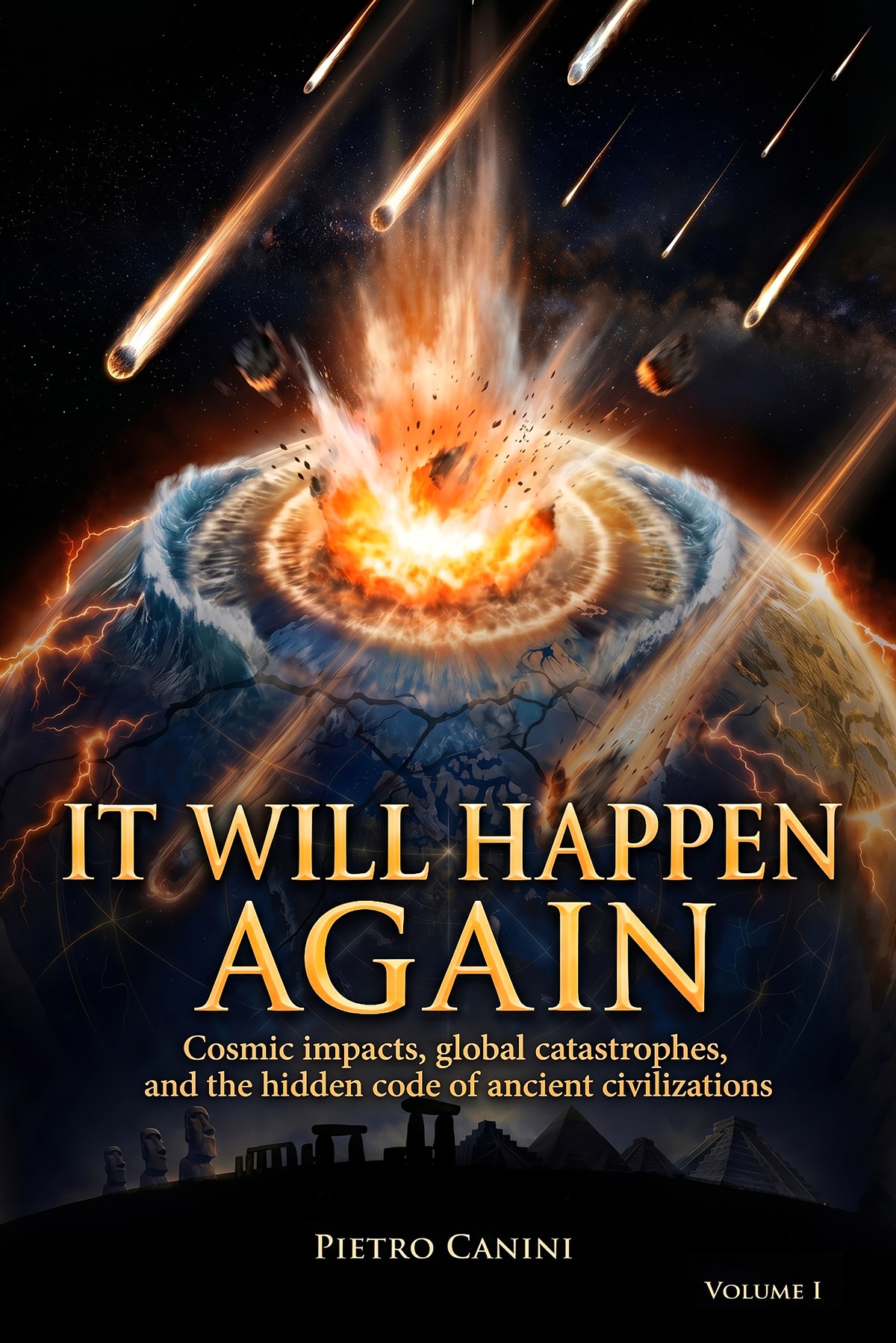
It Will Happen Again
Cosmic impacts, global catastrophes and the hidden code of ancient civilizations
It has already happened. About 12,850 years ago, fragments of a giant comet struck the North American ice sheet at tens of kilometers per second. The energy released was equivalent to thousands of nuclear bombs. In a matter of seconds, trillions of tons of water vaporized. A continent caught fire. Ninety percent of North American megafauna — mammoths, mastodons, saber-toothed tigers — went extinct. For 1,300 years, winter never ended. The scientific community calls it the Younger Dryas impact, and the evidence has tipped the debate in its favor.
But this book is not about the past. It is about a clock. A cosmic clock that has been ticking for tens of thousands of years, whose gears are the precession of the equinoxes, the orbit of a swarm of cometary debris millions of kilometers wide, and the climate cycles recorded in the planet’s oldest ice. A clock whose chimes have been recorded — with extraordinary precision — in the sacred texts of civilizations that should have had no contact with one another: the precessional numbers of the Vedas, the Sumerian shar, the Maya calendar, the Etruscan saecula.
For millennia, these civilizations tried to pass on a message. They encoded it in myths, in sacred numbers, in stone monuments designed to survive the next Flood. The message is the same, in every language, on every continent: it will happen again.
Nineteen chapters, an appendix with the inventory of sites aligned with the ancient poles, and a conclusion that walks you into Giza as into a machine, not a tomb.